Your rooftop panels often make more power at noon than your home needs. Where does the extra go? Net metering in India answers that question. It lets a grid-connected solar owner send surplus units to the electricity distribution company (DISCOM) and receive credit on the bill. In short, a two-way meter counts the units you import and export, and you pay only for the net difference.
This guide explains how net metering works, what the 2024 rule changes mean, how it connects to the PM Surya Ghar subsidy, and how the process runs in Telangana under TGSPDCL.
What Is Net Metering in India and How Does It Work?
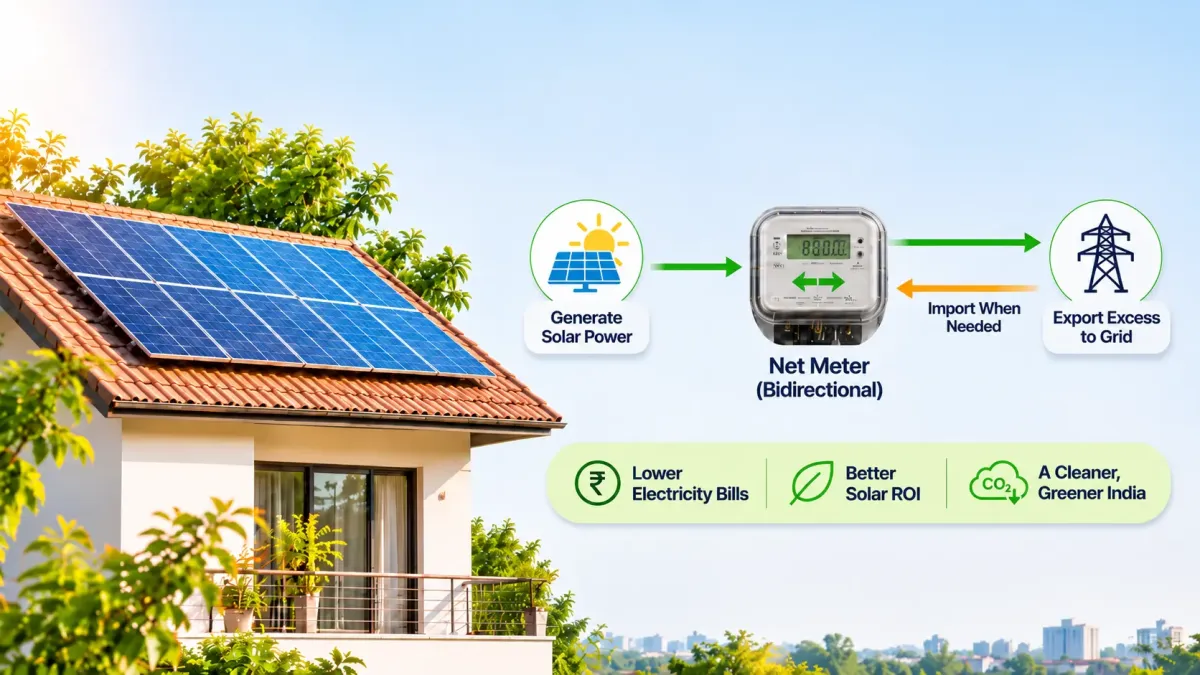
A standard meter counts only the electricity you draw from the grid. A net meter, also called a bi-directional meter, counts both directions. It records the units you import when the sun is down and the units you export when your panels produce more than you use.
At the end of the billing cycle, the DISCOM subtracts your exports from your imports. You pay for the net units only. If you export more than you import, the surplus becomes a credit.
Take a simple example. Your home imports 220 units in a month and exports 180 units. The bill covers 40 units. These numbers are illustrative and do not come from any FutureVolt project.
Keep two terms apart. We measure solar capacity in kilowatts (kW), which describes the size of the system. We measure energy in kilowatt hours (kWh), which describes the units you generate and use. A 3 kW system does not deliver 3 units every hour. Output depends on sunlight, shading, panel angle and temperature.
Net metering also does not store power. It only credits the surplus. A grid-connected system without a battery switches off during a power cut for safety reasons, so net metering does not give you backup.
Net Metering vs Gross Metering: Which One Applies to You?
Under net metering, you use your own solar power first and export the rest. Under gross metering, the DISCOM records all your solar generation as a sale, and you pay the normal tariff for all the power you consume.
Most homes and small businesses prefer net metering. Each solar unit you use offsets a unit you would otherwise buy at the retail tariff. Gross metering usually suits larger systems.
The national rule sets the dividing line. The Ministry of Power allows net metering for loads up to 500 kW or up to the sanctioned load, whichever is lower. For loads beyond 500 kW, gross metering applies. Some states also offer group net metering and virtual net metering for shared buildings and colonies.
What Changed Under the 2024 Consumer Rules?
In February 2024, the Ministry of Power amended the Electricity (Rights of Consumers) Rules. Three changes matter for rooftop owners, according to this summary of the amendments.
First, systems up to 10 kW no longer need a technical feasibility study. Second, for larger systems, the study timeline fell from twenty days to fifteen days. If the DISCOM does not finish the study in time, the approval counts as granted. Third, for systems up to 5 kW, the DISCOM must carry out any distribution system strengthening and bear its cost.
Most home systems fall below the 10 kW line, so these changes cut approval delays for homeowners.
Does Net Metering Matter for the PM Surya Ghar Subsidy?
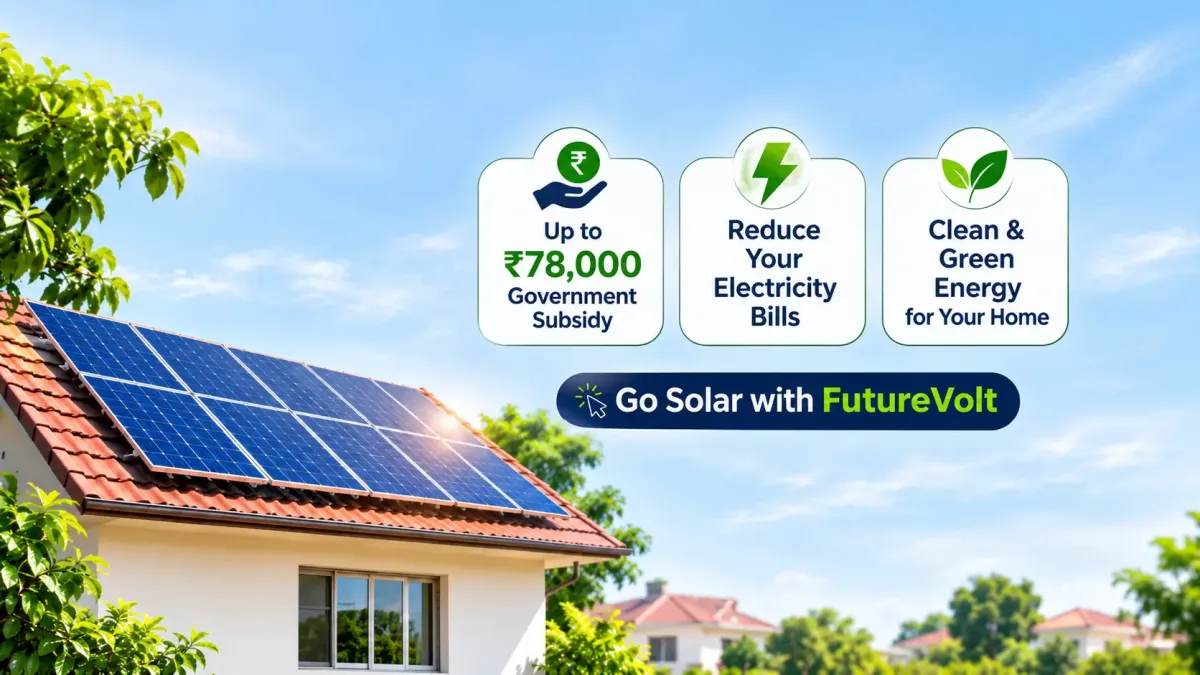
Yes, because the subsidy supports grid-connected rooftop systems. Under PM Surya Ghar Muft Bijli Yojana, the benchmark subsidy is ₹30,000 for 1 kW, ₹60,000 for 2 kW and ₹78,000 for 3 kW or higher. The portal also tells DISCOMs to ensure net meters are available.
After installation, the DISCOM fits the net meter, inspects the plant and approves the application on the portal. The DISCOM processes the subsidy only after that approval, so a delay in the net meter can delay the subsidy.
FutureVolt's PM Surya Ghar subsidy page lists the slabs and eligibility points in one place. Always confirm current figures on the national portal before you apply, because scheme terms can change.
TGSPDCL Net Metering: How the Process Works in Telangana
Telangana follows its own regulation on top of the national rules. The Telangana Electricity Regulatory Commission (TGERC) replaced its 2016 net metering rules with the Rooftop Solar PV Grid Interactive Systems Regulation 2025. Industry reports say it took effect on 15 November 2025.
According to those reports, the regulation allows net metering up to 500 kWp. Residential and government consumers can size a system up to their full sanctioned load. Industrial, commercial and other consumers can go up to 80% of it. The DISCOM has 15 working days to issue feasibility after a complete application, and systems up to 10 kWp need no technical feasibility study. The application fee is ₹2,500 for low tension consumers and ₹15,000 for high tension consumers. The regulation also requires smart meters.
The reports add that Telangana DISCOMs settle a monthly surplus at the lowest solar tariff they discovered in the previous financial year. Rules and fees change, so check the TGSPDCL rooftop solar FAQs for the current form and process before you apply. Parts of that page may predate the 2025 regulation.
Benefits and Limits of Net Metering
The main benefit is simple. Every unit your panels make and you use offsets a unit you would have bought from the grid. You also skip the cost of batteries, because the grid acts as your storage in an accounting sense.
Your usage pattern decides how much you gain. A shop, office or factory that runs mostly in daylight uses most of its solar power on the spot. A home with a heavy evening load exports more by day and imports more at night, so credits matter more there.
Net metering has limits too. Credit and settlement rules differ by state. Surplus paid in cash may earn a lower rate than the retail tariff you pay. Approval and meter timelines also depend on your DISCOM, and a power cut still switches your system off. Weigh these points before you choose a system size.
How to Get a Net Meter Connection: Step by Step
The exact order varies by state, but the path looks like this:
- Check your sanctioned load, roof space and shading.
- Size the system against your monthly bills. A solar calculator gives a quick estimate of system size and savings.
- Apply to the DISCOM, or through the national portal if you want the subsidy, before you install anything.
- Install the system with a registered vendor, using modules and inverters that meet the rules.
- Let the DISCOM install the net meter and inspect the plant.
- Receive the DISCOM's approval, after which billing runs in net mode.
Common Mistakes to Avoid
Many delays come from a few avoidable errors. Installing before you register the application on the portal is the biggest one, since it can put the subsidy at risk. Oversizing beyond your sanctioned load limit is another, because the DISCOM may cap the approved capacity.
Ignoring shade also hurts. A shaded panel produces less, so you export less. Dust has the same effect, which is why regular cleaning and servicing matter.
Weak record keeping causes trouble later. Keep copies of the application, the vendor agreement, the inspection report and the DISCOM approval. You may need them for the subsidy claim and for any billing query after installation.
Finally, do not expect a zero bill every month. Fixed charges and taxes still apply, even when your exports match your imports.
How FutureVolt Can Help
According to its website, FutureVolt delivers solar power for homes, businesses and industries. It covers design, installation, government approvals, and ongoing operation and maintenance. The site also lists empanelment with TGREDCO in Telangana and NREDCAP in Andhra Pradesh.
If you own a home, start with FutureVolt's residential rooftop solar page. Ask any installer, including FutureVolt, to confirm in writing who handles the net meter application, the inspection and the subsidy paperwork.
Conclusion
Net metering turns spare daytime power into bill credit, but only when approvals and metering are done correctly. Check your sanctioned load first. Get DISCOM approval before you install. Then plan for the net meter inspection, since it also supports your subsidy claim.
If you want a clear view of system size, approvals and costs for your property, share your requirement with the FutureVolt team and request a free consultation.