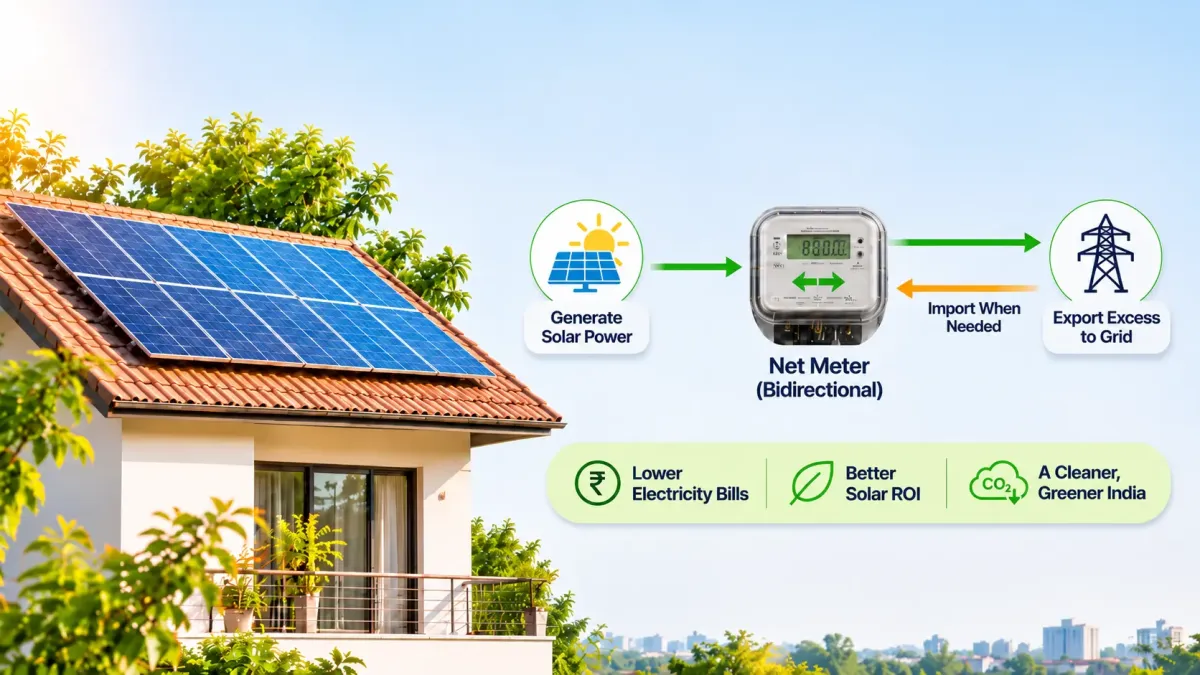
Is solar worth it in India? For many homes and businesses with a suitable roof and steady daytime power use, the answer is yes. The better question is how fast your system pays for itself. That depends on your tariff, your usage, your roof, the subsidy you qualify for and the price you pay for the system.
This guide gives you a way to test the numbers yourself. It includes a worked example, the costs people forget and the cases where solar may not pay.
What Decides Whether Solar Pays Off?
Start with your tariff. Every unit your panels supply replaces a unit you would buy from the electricity distribution company (DISCOM). A higher tariff means each solar unit saves more. Tariffs differ by state and by consumer category, so use the rate on your own bill.
Next, look at your usage. Solar works best when you use power in the daytime. A shop, office or factory that runs from morning to evening uses most of its solar power on the spot. A home that uses most power at night depends more on credits for exported units.
Your roof matters just as much. You need clear, shade-free space facing the sun. A Telangana DISCOM guide on rooftop solar and net metering says a 1 kW system needs about 10 square metres of roof. It also says a south-facing 1 kW system generates about 1,000 to 1,200 units a year, and east or west facing roofs produce roughly 20% less. Parts of that page may be out of date, so treat the figures as a guide.
Finally, look at system price and subsidy. They set the amount you must earn back.
A Worked Payback Example
Let us test a 3 kW home system in Hyderabad. We use a real market price. A 3 kW system in Telangana costs about ₹1,95,000 before subsidy, according to Desi Utility. Eligible households receive a maximum central subsidy of ₹78,000 for a 3 kW system under PM Surya Ghar, as TGSPDCL’s own push for rooftop solar explains. That brings the net cost to ₹1,17,000.
Now estimate the output. A 1 kW system on a south-facing roof generates about 1,000 to 1,200 units a year, and east or west roofs generate about 20% less. So a 3 kW system makes 3,000 to 3,600 units a year, or about 250 to 300 units a month.
Next, pick a typical Hyderabad home that uses 400 units a month. The FY 2026-27 tariff charges homes above 200 units ₹5.10 a unit for the first 200 units, ₹7.70 for the next 100 and ₹9.00 for the 301 to 400 band. Without solar, the energy charge comes to ₹2,690 a month. Solar cuts the units you buy from the grid to about 100 to 150 a month, which drops your bill to about ₹250 to ₹580. Yearly savings then land between ₹25,300 and ₹29,300.
Divide the net cost by the yearly saving. The simple payback is about 4 to 4.6 years.
Change the monthly usage to see the effect. A home that uses 600 units a month saves ₹28,200 to ₹33,600 a year, so payback drops to about 3.5 to 4.1 years. A home that uses only 250 units a month saves about ₹16,900 a year, because the system covers every unit. Payback stretches to about 6.9 years, and a smaller system suits that home better.
One Telangana rule matters here. Officials say the Gruha Jyothi scheme, which gives free power up to 200 units a month, made many middle class families less keen on rooftop solar, as Telangana Today reported. If your bill already sits at zero, solar saves you very little.
Treat this as a rough guide. A real quote may differ from the market price. The sum ignores fixed charges, electricity duty, degradation and repairs. TGSPDCL settles unadjusted surplus credits twice a year, in June and December, at the average power purchase cost, which is lower than the rate you pay. It is not data from a FutureVolt project, and no solar system carries a guaranteed return.
Costs and Losses the Simple Sum Misses
A fair check adds the costs that arrive later. Four items matter most.
First, plan for an inverter replacement. India Renewable Energy Consulting notes that the inverter is the only major rooftop component that needs replacing, with a typical life of 5 to 10 years, while panels should last 25 years or longer. Budget for one replacement.
Second, expect slow output loss. pv magazine India quotes IIT Bombay’s Anil Kottantharayil, who explains that panel makers guarantee 80% output after 25 years, which works out to about 0.8% loss a year. Your yearly savings will shrink a little as panels age.
Third, remember maintenance. Dust cuts output, so cleaning and checks protect your savings. Under PM Surya Ghar, the vendor must provide five years of free maintenance from commissioning.
Fourth, check how your DISCOM treats surplus power. Credit and settlement rules differ by state, and fixed charges stay on your bill. A zero bill is not guaranteed.
When Solar May Not Be Worth It
Solar does not suit everyone. Be honest about these cases.
If your monthly bill is very low, the yearly saving is small, and payback stretches out. If your roof is small, shaded or weak, you may not fit a useful system. If you do not own the roof, or you plan to move soon, you may not hold the system long enough to earn the money back.
A costly loan can also change the answer. If interest eats most of the saving, a smaller system or a larger down payment may work better. Compare the monthly instalment with your current bill before you sign.
How Subsidy, Loans and Tax Change the Answer
The subsidy shortens payback for homes. PM Surya Ghar pays ₹30,000 per kW up to 2 kW and ₹18,000 for the third kW, so the cap is ₹78,000. It covers grid-connected residential systems in the capex mode, where you buy the system. The scheme also requires domestically made modules. FutureVolt's subsidy page explains the slabs in one place.
Loans can remove the upfront cost. According to its website, FutureVolt works with multiple bank and NBFC partners and lists low-cost EMIs, with no collateral on most options. Its solar loan page shows the details. Confirm rates and terms before you commit.
Businesses have extra levers. The GST Council cut the tax on solar devices from 12% to 5% in September 2025, as Renewable Watch reported. Businesses may also claim accelerated depreciation. Rates and conditions change, so check them with a tax adviser.
How Your Tariff Type Changes the Math
Domestic tariffs in many states use slabs. The more units you use, the higher the rate per unit in the upper slabs. Solar offsets your highest-priced units first, so a home in a high slab often saves more per solar unit than a home in a low slab. Check the slab structure on your bill before you size a system.
Commercial and industrial tariffs work differently. Many have an energy charge for each unit and a separate demand charge based on your peak load. Solar cuts the energy charge well. It cuts the demand charge only if your peak falls during sunlight hours, and cloud cover can break that link. Ask your installer how the plant will affect each part of your bill.
Time-of-day rates add another twist. Some DISCOMs charge more at peak hours. Solar produces in the daytime, so check whether your costliest hours fall inside that window.
Four Myths That Skew the Decision
Myth one says solar needs no care. Panels need cleaning and an annual check, and the inverter needs replacing in time.
Myth two says the bill drops to zero. Fixed charges and taxes stay, so plan for a small bill.
Myth three says the subsidy pays for the system. The subsidy covers part of the benchmark cost, and you pay the rest. Myth four says all quotes are equal. Parts, warranties and service differ, and they decide how well the system performs over many years.
A Checklist Before You Decide
Answer these questions with real figures before you sign anything.
- What is my average monthly bill over the last 12 months?
- What rate do I pay per unit in my top slab?
- How much shade-free roof do I have?
- Do I own the roof, and will I stay for at least five years?
- What is the net cost after subsidy in a written, itemised quote?
- What do the warranty and the service plan cover?
- How will I pay, and what will the monthly instalment be?
If most answers look good, solar likely works for you. If several look weak, pause and recheck.
Use a Calculator Before You Decide
A solar savings calculator for India works best when you feed it real data. Use your latest bill, your roof area and your pincode. FutureVolt's solar calculator asks for your pincode and monthly bill range and gives an estimate of system size and savings.
Then ask installers for itemised quotes. Compare the cost per kW, the brand and model of each part, the warranty and the service plan. A low price with weak parts rarely pays off.
Conclusion
Solar is worth it when your tariff is high enough, your roof is usable and the net cost is low enough to earn back in a reasonable time. Run the sum with your own numbers. Include the inverter, the output loss and the upkeep.
Ready to see what solar could save for you? Talk to the FutureVolt team and book your free consultation today.