Electricity is one of the few operating costs a factory cannot negotiate. A Hyderabad unit on an 11 kV HT industrial connection pays ₹7.65 per unit in energy charges, plus a demand charge of ₹500 per kVA every month. That is why more owners now study commercial rooftop solar in India as a way to fix part of that cost for decades. Before you sign a quote, you need clear numbers. This guide covers cost, a worked Hyderabad ROI example, tax treatment and Telangana's metering rules.
What Is Commercial Rooftop Solar and How Does It Work?
Commercial rooftop solar is a solar PV plant on the roof of a business building, such as a factory shed, warehouse, hospital or mall. The plant supplies power to that building first. Panels produce DC power, and an inverter converts it into AC power for your machines, lights and cooling.
Businesses usually pick from three system types:
- On-grid: connects to the grid, uses no battery and costs the least. It generally switches off during a power cut.
- Off-grid: runs without the grid and needs batteries, so battery capacity limits it.
- Hybrid: combines solar, batteries and the grid to keep selected loads running during outages. It costs more upfront.
Most daytime-heavy businesses choose on-grid systems for savings. FutureVolt's commercial rooftop solar solutions page says the right choice depends on usage, operating hours, grid reliability, backup needs and budget.
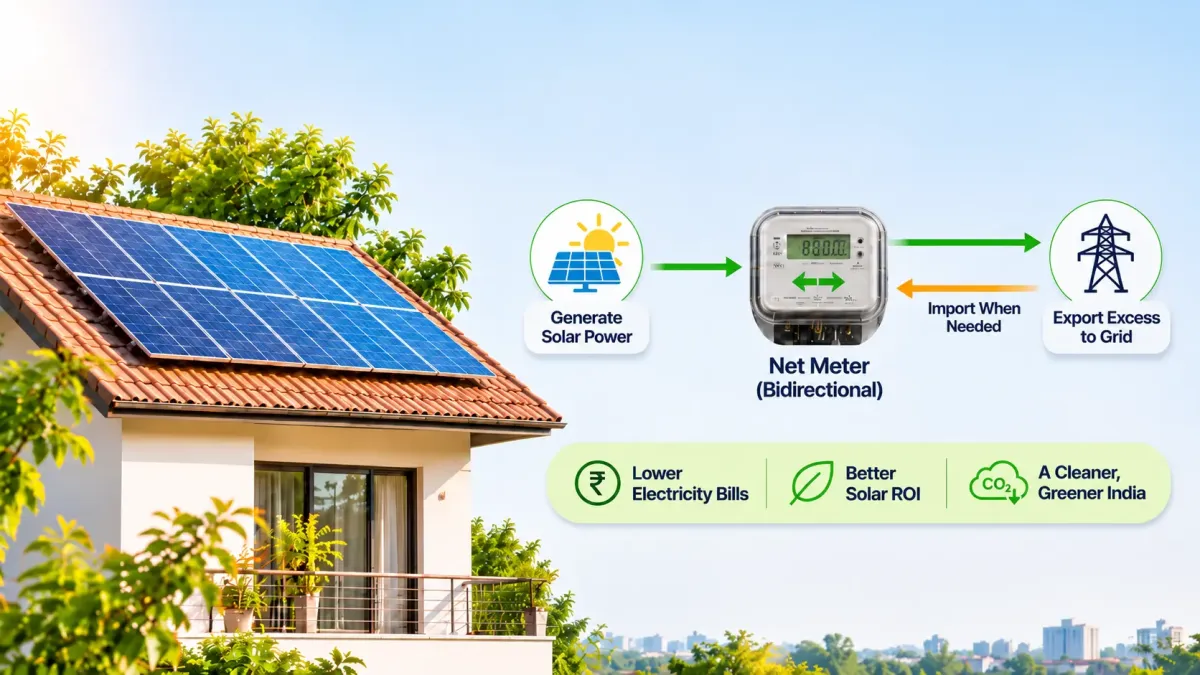
Metering decides how you use surplus power. Under net metering, a two-way meter records imports and exports, and you pay only for net units. Under gross metering, your plant sends all its output to the DISCOM, and you buy your own power at the normal tariff. Each state sets its own rules.
Commercial Rooftop Solar Cost in India
Several factors move your quote. Capacity matters most, because larger plants cost less per kW. Panel technology, inverter choice and the mounting structure come next, and the structure depends on whether your roof is RCC or metal sheet. Electrical work, roof condition, usable shadow-free area, grid approvals and operations and maintenance (O&M) terms add to the total.
Quotes published by Indian installers in 2026 generally fall between ₹35,000 and ₹55,000 per kW for on-grid plants. Treat the table below as a planning range, not a price list.
| System capacity | Indicative installed cost | What changes the price |
|---|---|---|
| 25 kW | ₹9 lakh to ₹14 lakh | Small plants cost more per kW |
| 50 kW | ₹18 lakh to ₹28 lakh | Roof type and cable run length |
| 100 kW | ₹35 lakh to ₹55 lakh | Panel and inverter brand, structure height |
| 250 kW | ₹88 lakh to ₹1.4 crore | Scale benefits, approvals, evacuation work |
| 500 kW | ₹1.75 crore to ₹2.75 crore | Transformer or panel upgrades at the site |
These figures are estimates. Your actual quotation depends on a site inspection, equipment selection and project needs. Confirm whether a quote includes GST and approval charges.
How to Calculate Commercial Solar ROI in India
Start with three simple formulas:
- Annual net saving = (units generated × tariff you avoid) minus yearly O&M cost
- Payback period (years) = installation cost ÷ annual net saving
- Simple ROI (%) = (annual net saving ÷ installation cost) × 100
Two details change the result. First, solar offsets only your energy charge, so your demand charge stays on the bill. Second, time-of-day pricing matters. On TGSPDCL's FY 2026-27 tariff, HT industrial consumers get a ₹0.50 per unit rebate between 10 am and 6 pm, when panels produce. So the tariff you avoid is ₹7.65 minus ₹0.50, or ₹7.15.
Hypothetical example: a manufacturing unit in Hyderabad
This is an illustration, not a customer result or a verified project.
| Assumption | Value |
|---|---|
| System size | 100 kWp, on-grid |
| Installed cost | ₹42 lakh (₹42,000 per kWp) |
| Yearly generation | 1,400 kWh per kWp, so 1,40,000 units |
| Self-consumption | 100% during working hours |
| Avoided tariff | ₹7.15 per unit |
| Yearly O&M | ₹50,000 |
Gross saving works out to 1,40,000 × ₹7.15 = ₹10,01,000. After ₹50,000 of O&M, the net saving is ₹9,51,000. Payback comes to about 4.4 years (₹42,00,000 ÷ ₹9,51,000), and simple ROI is about 22.6% a year.
Real projects are less tidy. Panel output falls slowly each year, inverters often need replacement after 10 to 15 years, and tariffs change. FutureVolt's practical solar payback check shows a second worked example.
Tax Benefits of Commercial Rooftop Solar in India
The Income-tax Act, 2025 came into force on 1 April 2026. It uses "tax year" instead of the older financial year and assessment year labels, so Tax Year 2026-27 covers what you may know as FY 2026-27 and AY 2027-28.
Depreciation is the main income tax benefit. If your business owns the plant and uses it for business, you can claim depreciation on it. Published summaries of the new rules list solar power generating systems under renewable energy devices at 40% on a written down value basis. Check the rate schedule in the Income-tax Rules, 2026 with your chartered accountant before you rely on it.
Keep these limits in mind:
- Depreciation applies to the block of assets, not to a single invoice.
- An asset used for fewer than 180 days in the year usually gets half the rate that year.
- You must own the plant. If a third party owns it, that owner claims depreciation.
- Some manufacturers may qualify for additional depreciation on new plant, but only under specific conditions. Do not assume it.
- Depreciation reduces taxable income. It is not a refund, a subsidy or a fixed share of tax saved.
In the Hyderabad example above, 40% of ₹42 lakh is ₹16.8 lakh. At an assumed 25% tax rate, that cuts first-year tax by about ₹4.2 lakh. Lower electricity costs also raise your taxable profit, so account for that too.
GST changed too. From 22 September 2025, the GST Council cut GST on solar power devices from 12% to 5%. The effective rate on a turnkey contract depends on how the supply is invoiced, and input tax credit depends on your registration. Ask your tax professional to review the quote.
Commercial Rooftop Solar Subsidies and Government Policies in India
Many business owners ask about PM Surya Ghar: Muft Bijli Yojana. It supports residential households. MNRE's operational guidelines state that no central financial assistance goes to non-residential segments, including commercial and industrial consumers. Housing societies can receive support only for common facilities, so a factory, shop or hospital cannot claim the residential subsidy.
Your benefits come from depreciation, the lower GST rate, DISCOM metering rules and tariff savings. Ask your state agency and DISCOM whether any state support applies to your category before you budget for it.
Commercial Rooftop Solar in Hyderabad and Telangana
Hyderabad's businesses buy power from TGSPDCL, and the Telangana Electricity Regulatory Commission sets the rules. Its Rooftop Solar PV Grid Interactive Systems Regulation, 2025, effective 15 November 2025, replaced the 2016 net metering rules. It covers net, gross, group and virtual net metering. Industrial and commercial consumers face a cap tied to sanctioned load or contracted demand, which industry reports put at 80%. Confirm the current limit with TGSPDCL before sizing your plant.
Tariffs shape the payoff. For FY 2026-27, TGSPDCL lists ₹7.65 per unit for HT-I(A) industry at 11 kV, ₹8.80 for HT-II(A) others, and ₹9.90 for LT-II(B) commercial loads of 101 to 300 kW. Commercial users often save more per unit, but have less roof space.
Good rooftop candidates include factory sheds around Hyderabad, warehouses, hospitals, offices and campuses. TGREDCO, the state renewable energy agency, publishes rooftop tenders and a vendor registration page, and FutureVolt states on its website that it is empanelled with TGREDCO. Approval usually runs through a DISCOM application, a feasibility check, meter installation and commissioning. FutureVolt's guide to how net metering works covers the Telangana process.
Is Commercial Rooftop Solar Worth the Investment for Your Business?
It usually suits businesses that run during the day, such as factories on day shifts, offices, hospitals, schools and warehouses. Pull your last 12 bills and check what share of your units you use between 10 am and 6 pm. The higher that share, the faster the payback.
Also test roof area, strength and shade, the remaining roof life, how long you will occupy the building, your cash position or loan terms, and whether you have enough taxable profit to use depreciation.
Solar may not pay well for a night-heavy plant, a shaded or weak roof, a short lease or a very low tariff. In those cases, a smaller system or no system may work better.
How to Choose the Right Commercial Rooftop Solar Solution
Good projects start with design, not price. Ask for a plan built on your actual load data, then compare vendors on panel and inverter makes with written warranties, roof load checks, testing and commissioning records, experience with DISCOM approvals, itemised quotes and O&M response times.
FutureVolt's pages describe a process that covers a free site survey, system design, installation, government approvals and O&M. Its industrial rooftop solar for factories page adds rooftop and ground-mount options for larger loads. Ask any vendor, including FutureVolt, to put specifics in writing.
Conclusion
Commercial rooftop solar in India can work as a long-term business investment when you size it from real load data and test the numbers honestly. Compare installation cost, the tariff you will avoid, payback, depreciation and your DISCOM's rules before you commit. Residential subsidies do not apply to businesses, so confirm every tax point with a qualified professional.
If you run a factory, warehouse or commercial property, explore FutureVolt's commercial solar options and request a consultation. A site survey and a clear design will tell you more than any generic estimate.